

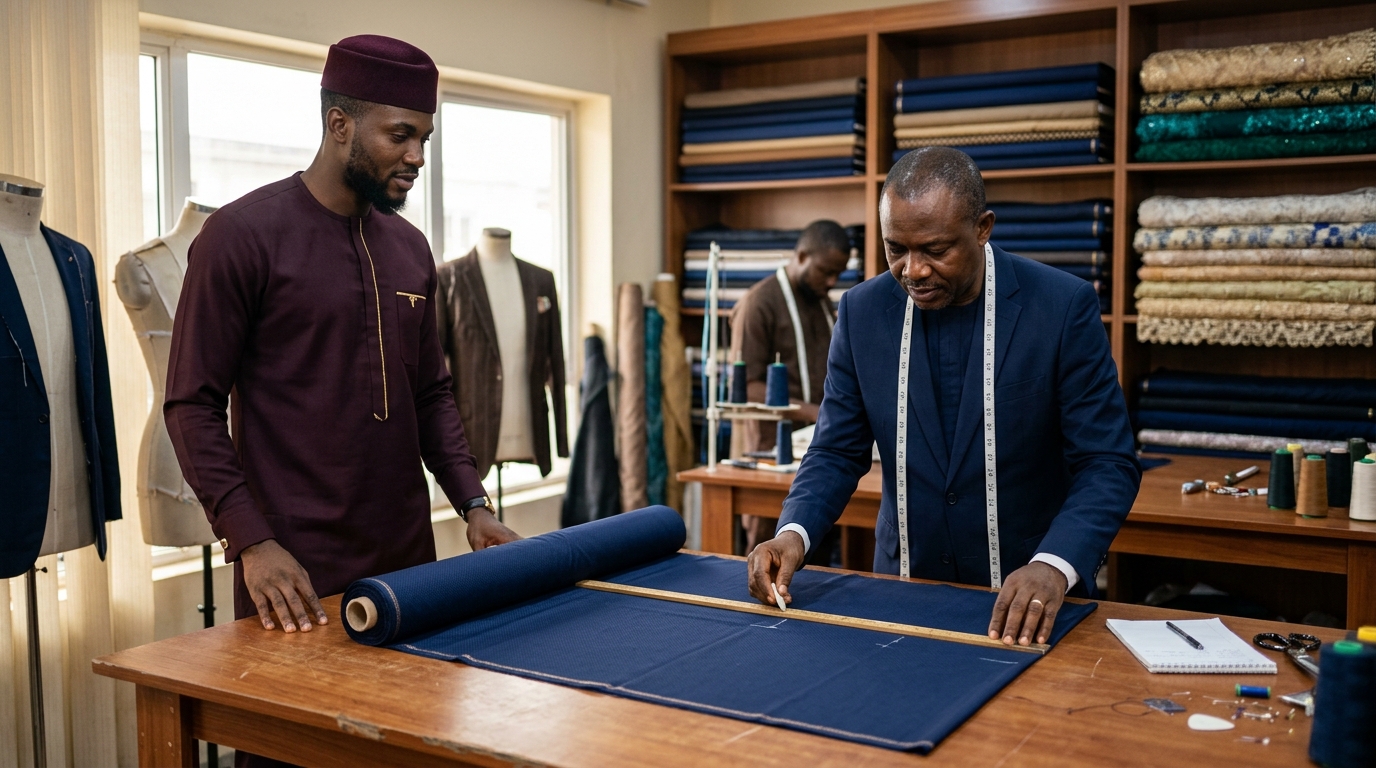
What Does 2.5 Yards Mean When Buying Men’s Fabric?
What Does 2.5 Yards Mean When Buying Men’s Fabric in Nigeria?
You are shopping for a men’s fabric online and you see:
“2.5 yards.”
You place the order and start thinking about your Senator, Kaftan or native outfit.
Then your tailor asks:
“How many yards did you buy?”
You answer:
“2.5 yards.”
And suddenly the questions begin.
Is 2.5 yards enough?
Is it enough for the trousers?
Does 2.5 yards mean one complete outfit?
Why do some sellers mention yards, while others talk about pieces, cuts or trouser lengths?
This confusion is common because fabric is not always sold and described in exactly the same way across the Nigerian market.
And when you’re buying men’s fabric, understanding what your quantity actually represents can save you from buying too little—or spending money on fabric you don’t need.
First: What Is a Yard of Fabric?
A yard is a unit of length.
One yard is 36 inches, which is approximately 0.914 metres.
But there is an important detail many shoppers overlook:
A yard tells you the length of the fabric, not its width.
That matters because two fabrics can both be sold as 2.5 yards while having different widths.
So when you’re buying fabric, don’t ask only:
“How many yards?”
Also ask:
“What is the width?”
Fabric quantity is really a combination of length and width, not length alone.
So, What Does 2.5 Yards Actually Give You?
There is no universal answer such as:
“2.5 yards = one men’s outfit.”
It depends on:
- Your height
- Your body size
- The outfit
- The cut
- The fabric width
- Sleeve length
- Trouser length
- Whether the design is fitted or loose
- Whether embroidery or decorative borders affect cutting
For many men’s traditional outfits, 2.5 yards would generally be considered a limited quantity rather than a guaranteed full outfit allowance.
Current Nigerian fabric sellers commonly quote around 3–4 yards for an average Senator outfit, with larger or longer designs sometimes requiring more. One Nigerian fabric retailer, for example, currently gives a general range of 3–4 yards for Senator and 3–5 yards for Kaftan, while other Nigerian fabric sources recommend confirming the exact amount with the tailor based on height and design.
That is why buying 2.5 yards without checking your tailor’s requirement can be risky.
Why 2.5 Yards Can Mean Something Different Depending on the Seller
Here’s where Nigerian fabric terminology can become confusing.
A seller may list fabric in:
- Yards
- Metres
- Cuts
- Pieces
- Trouser lengths
- Bundles
- Packs
These descriptions are not always interchangeable.
For example, one Nigerian marketplace source describes an average Senator outfit as requiring approximately 3 yards, and notes that this corresponds to about 2.5 trouser lengths.
That is very different from saying:
“2.5 yards of fabric.”
The two measurements should not automatically be treated as the same thing.
This is one of the reasons buyers need to read the product description carefully.
2.5 Yards of Fabric Is Not the Same as 2.5 Metres
This is another common mistake.
A yard is approximately 0.914 metres.
So:
2.5 yards ≈ 2.29 metres.
And:
2.5 metres ≈ 2.73 yards.
That may seem like a small difference, but when a tailor is working with limited fabric, those extra inches can matter.
So when buying online, make sure you know whether the seller is quoting:
yards
or
metres.
Do not assume they are the same.
Is 2.5 Yards Enough for a Senator Outfit?
For most complete men’s Senator outfits, 2.5 yards should not be assumed to be enough.
The exact requirement depends on your measurements and design.
A standard short-sleeved Senator outfit may require around 3–4 yards for an average build, while longer styles or larger body sizes can require more.
This is why your tailor should ideally give you the quantity before you purchase the fabric.
For example:
A shorter, simpler design
May require less fabric.
A longer Senator
May require more.
A larger body size
May require more.
A design with additional panels or details
May require additional fabric.
Patterned fabric
May require extra allowance for pattern placement.
So there is no responsible one-size-fits-all answer.
What About a Men’s Kaftan?
The same principle applies.
Current Nigerian fabric retailers commonly recommend around 3–5 yards for men’s Kaftan styles, depending on the person’s size and the design.
A simple short Kaftan may require less than a long, flowing design.
This is why the word “Kaftan” alone isn’t enough to calculate the quantity.
You need the actual style.
What About Agbada?
This is where 2.5 yards definitely becomes very different from a complete outfit requirement.
A full Agbada involves considerably more fabric because you’re dealing with a large outer garment as well as the inner outfit.
Current Nigerian fabric retailers commonly quote roughly 6–10 yards for an Agbada/Babban Riga-type set, depending on size and design.
So if someone is buying 2.5 yards for a men’s Agbada, they are almost certainly buying only part of what is required, unless they already have other fabric components.
Why Fabric Width Matters
This might be the most important thing buyers overlook.
Imagine two fabrics:
Fabric A: 2.5 yards wide enough for the intended cutting layout
Fabric B: 2.5 yards but narrower
They have the same length.
But they do not necessarily provide the same usable fabric area.
This matters when cutting:
- Sleeves
- Trousers
- Front panels
- Back panels
- Collars
- Larger garment sections
So when buying men’s fabric, ask for the width as well as the yardage.
Why Your Body Size Changes the Amount You Need
Fabric calculations are not based on the average Nigerian man’s measurements.
Your height and build matter.
A tall customer may require more length.
A broader customer may require more material across the garment.
A slim customer may need less.
This is why you may see one seller recommend 3 yards while another recommends 4 yards for what appears to be the same style.
They may be working from different assumptions.
One Nigerian retailer currently advises customers to consider height, size and design before deciding how many yards to purchase.
The Design You Choose Can Change Everything
A simple Senator and a highly detailed Senator don’t necessarily consume the same amount of fabric.
Extra fabric may be required for:
- Longer sleeves
- Wider trousers
- Oversized silhouettes
- Extra panels
- Cuffs
- Large collars
- Layered designs
- Pattern matching
This is especially important when using fabrics with obvious patterns.
If your tailor needs to align the design across different sections, wastage can increase.
So don’t buy exactly the minimum unless your tailor has confirmed the amount.
What About Fabric With Borders or Large Patterns?
This is another reason the number on the product page doesn’t tell the entire story.
A fabric can have:
- A decorative border
- Large motifs
- Directional patterns
- Repeating designs
- Embroidered sections
Your tailor may need to position these elements carefully.
That can affect how much of the fabric is actually usable.
A 2.5-yard piece with a strategically placed border is not always equivalent to 2.5 yards of a plain fabric.
The usable quantity depends on the design.
Why Buying Exactly What You Need Can Be Risky
Let’s say your tailor says:
“Buy 3 yards.”
You buy exactly 3 yards.
Then the tailor discovers that:
- The design needs extra length
- The fabric has a directional pattern
- Some of the edge is damaged
- The cutting layout creates unavoidable waste
Now you have a problem.
There is no extra fabric.
And if that colour or design sells out, finding an exact match later may be difficult.
This doesn’t mean you should always buy excessive quantities.
It means you should ask your tailor whether a small allowance is advisable for your particular fabric and design.
What Does 2.5 Yards Mean When Shopping Online?
When you see 2.5 yards on an online fabric listing, read the product information carefully.
Check:
Is it 2.5 continuous yards?
This matters because a continuous piece is easier to cut than separate pieces.
What is the fabric width?
Don’t assume all fabrics have the same width.
Is the price for 2.5 yards total?
Some listings may describe multiple pieces or quantities.
Is the fabric sold as a set?
A product might contain 2.5 yards plus another separate piece.
Are there accessories?
Do not assume a cap, lining or additional fabric is included unless the product description says so.
Online Nigerian fabric listings demonstrate how much product packaging can vary: some products specify exact yardage, while others describe multiple pieces or pack formats.
2.5 Yards vs 4 Yards: What’s the Difference?
Think of it simply.
2.5 yards gives you approximately 2.29 metres of fabric length.
4 yards gives you approximately 3.66 metres.
That’s a difference of 1.5 yards, or about 1.37 metres.
For men’s tailoring, that additional amount can make a significant difference in what can be cut from the fabric.
But more fabric does not automatically mean a better purchase.
The right amount is the amount your particular design and measurements require.
Should You Ask Your Tailor Before Buying?
Absolutely.
This may be the easiest way to avoid a costly mistake.
Before ordering, send your tailor:
Your height
Your approximate size
A picture of the desired style
The exact fabric you’re considering
Then ask:
“How many yards of this fabric do I need?”
This is much better than asking:
“How many yards does a Senator normally need?”
Because your tailor is calculating for you, not an imaginary average customer.
A Simple Men’s Fabric Quantity Guide
Use this table as a general starting point, not a guaranteed measurement:
| Outfit | Common General Range |
|---|---|
| Senator | 3–4 yards |
| Kaftan | 3–5 yards |
| Agbada/Babban Riga set | 6–10 yards |
| 2.5 yards | Limited quantity; confirm with tailor |
Current Nigerian fabric retailers publish similar broad ranges, while noting that height, size and design can change the requirement.
The Biggest Mistake: Thinking Yardage Is the Whole Story
When buying men’s fabric, people often focus on the number:
“I bought four yards.”
But four yards of what?
The complete picture includes:
Length
Width
Fabric construction
Design
Pattern
Your measurements
Tailoring style
Those factors work together.
That’s why a fabric seller can help you understand the product, but your tailor should have the final say on the exact quantity required for your garment.
Before You Buy Men’s Fabric, Ask These 6 Questions
Save this list for your next fabric purchase:
1. How many yards am I getting?
2. What is the fabric width?
3. Is the fabric supplied in one continuous piece?
4. What outfit am I making with it?
5. Has my tailor confirmed the quantity?
6. Will the design or pattern require extra fabric?
Six questions can save you from a very frustrating tailoring experience.
Shop the Right Amount of Men’s Fabric at Subtle Fabrics
At Subtle Fabrics, we understand that buying fabric isn’t just about choosing a beautiful colour.
You also need to know what you’re buying and whether it makes sense for the outfit you want to create.
Our men’s fabric collection includes options such as Atiku, Brocade, Damask, Lace, Velvet and other quality fabrics suitable for traditional outfits and special occasions.
Whether you’re shopping for a Senator, Kaftan, Agbada or men’s Aso Ebi, start with the fabric—and make sure you know how much you actually need.
The goal isn’t to buy more fabric.
It’s to buy the right amount of the right fabric.
Final Thoughts
So, what does 2.5 yards actually mean when buying men’s fabric?
It means you have 2.5 yards of fabric length, approximately 2.29 metres, but that number alone does not tell you whether you have enough for your outfit.
Your fabric width, body size, outfit design, pattern and tailoring requirements all matter.
For many men’s traditional outfits, 2.5 yards would be below the commonly quoted amount for a complete Senator or Kaftan, while an Agbada generally requires substantially more.
So before clicking “Buy Now,” ask the question that matters most:
“Is this enough for the outfit I want to make?”
And the best person to answer that is usually your tailor.


